
Pay2Tax

If you’ve ever wondered whether IT jobs really pay more than Non-IT jobs, you’re not alone. This is one of the most common salary questions people ask worldwide. And the real answer isn’t as simple as “IT earns more” or “Non-IT is catching up.” Take-home pay depends on many moving parts — role, skills, bonuses, taxes, and even how your salary structure is designed.
Let’s break this down in simple words so you can understand who actually ends up with more money in their bank account.
Why People Think IT Always Pays More
For years, tech jobs have been seen as high-salary roles. And in many markets, they do offer strong packages. But that doesn’t automatically mean IT always wins.
Here’s the trick:
Take-home salary is more than just the number printed on your offer letter.
It depends on how each industry structures pay and what deductions apply.
Before comparing IT and Non-IT, we need to understand what goes out of your salary every month.
IT companies often offer:
Non-IT companies often offer:
A higher base salary usually means higher taxes, so sometimes an IT employee with a big base amount may actually take home less than expected.
IT roles often include:
Non-IT roles may include:
Some bonuses are taxed heavily, depending on the country. This directly affects how much arrives in your bank account.
Common deductions worldwide include:
In many IT roles, contributions are higher because salaries are structured differently. In Non-IT, contributions might be lower but the base pay might also be lower.
This mix often surprises people.
When I was analyzing salaries for different clients, I used a simple online salary-to-tax calculator to quickly check how these deductions affect real take-home pay. Having a tool that instantly shows how your numbers change helps you understand the real difference between IT and Non-IT income without doing any manual math.
Let’s take a simple, easy example.
Example Scenario
Two people earn the same annual salary — let’s say $50,000 (just a round global number).
IT Employee (Sample Structure)
Non-IT Employee (Sample Structure)
Comparison Table
| Category | IT Employee | Non-IT Employee |
|---|---|---|
| Base Salary | Higher | Moderate |
| Allowances/td> | Fewer | More |
| Bonuses | Higher but taxed | Moderate |
| Deductions | Higher | Lower |
| Overtime | Rare | Common in many industries |
| Take-Home Pay | Sometimes lower than expected | Sometimes higher than expected |
Result:
Even when the total salary is the same, the Non-IT employee may take home more in certain cases simply because of the way their pay is structured.
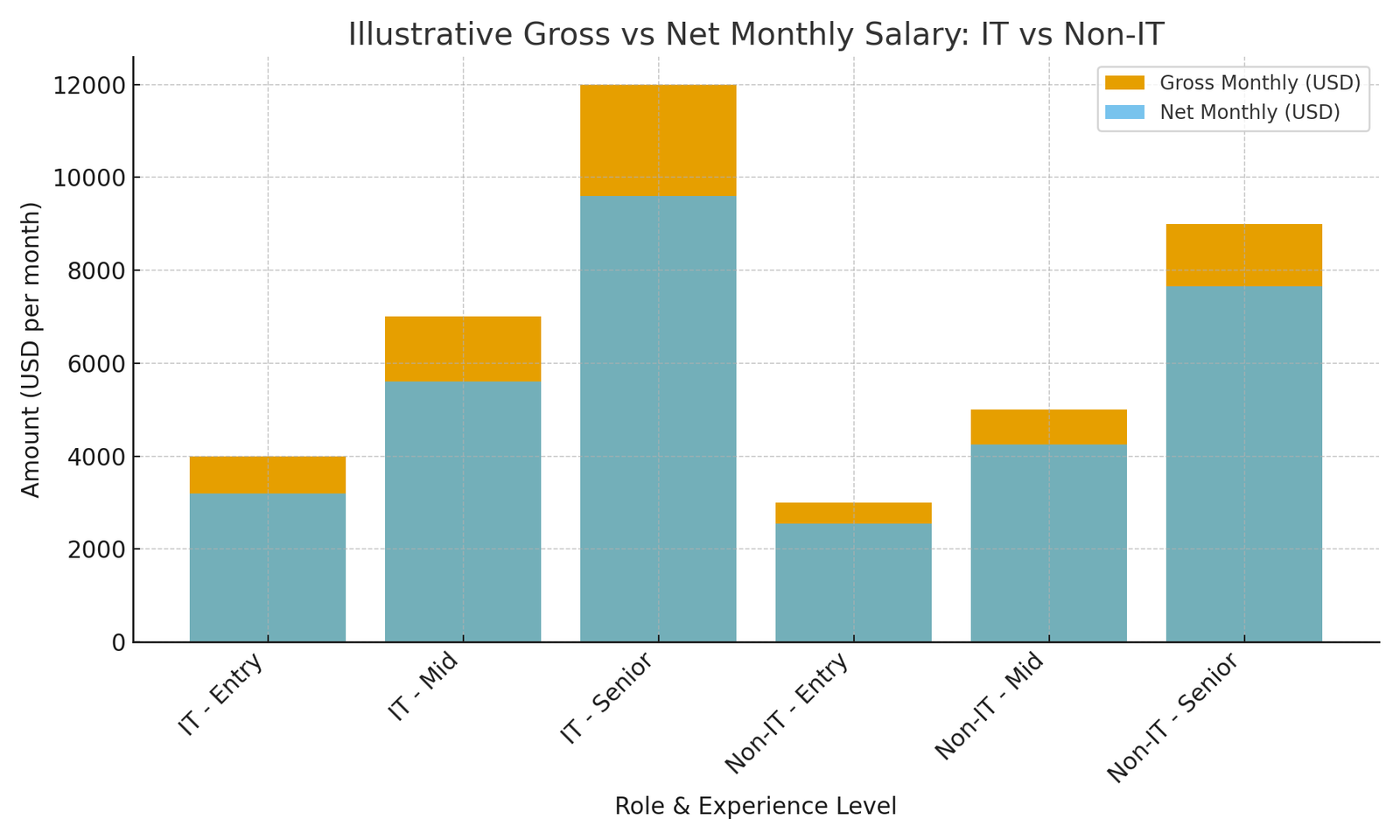
This chart above will help you understand the salary comparison in easier way.
There are plenty of situations where IT professionals clearly take home more.
Here’s why:
But the important part is this:
IT salaries vary sharply based on skill.
A beginner with basic skills may earn less take-home than an experienced Non-IT supervisor.
Non-IT roles can offer surprisingly high take-home pay because:
For example, many Non-IT roles in logistics, operations, manufacturing, hospitality, or aviation include multiple allowances that reduce taxable income.
When you compare take-home salaries using a tax calculator, this becomes very obvious — sometimes shockingly so.
This is the part most people overlook.
IT Salary Structure tends to be:
Non-IT Salary Structure tend to be:
This is why two employees earning the same gross salary can walk home with very different net salary.
Once you start checking your numbers with a salary-to-tax calculator, you begin to understand how your structure impacts your pocket every month.
This is the part people rarely say out loud, so I’ll say it clearly:
A highly skilled Non-IT worker can take home more than a low-skilled IT worker.
Examples:
These roles may have:
And their take-home pay can easily exceed entry-level IT salaries.
Across most countries, the pattern is similar:
IT roles dominate in:
Non-IT roles dominate in:
So who earns more?
There is no universal winner.
It always depends on:
The smartest thing you can do is compare your gross vs net using a calculator instead of relying on assumptions.
Here’s the simplest way to decide:
Choose IT if you want:
Choose Non-IT if you want:
And regardless of which industry you choose, keep checking how different salary structures influence your net income. Even a small change in allowances or deductions can change your final take-home amount more than you think.
A simple salary-to-tax calculator can help you compare different structures instantly while negotiating or planning your next role.
Not always. IT may offer higher gross salaries, but deductions can also be higher. Sometimes a Non-IT employee with more allowances ends up with a better take-home amount.
Many Non-IT roles involve fieldwork, shift duties, or industry-specific risks. Employers compensate for this through allowances, which can also reduce taxable income in some countries.
Compare the salary structures. Use an online tool that breaks down taxes and deductions so you clearly see your real earnings instead of guessing.